Honestly, in my view, Gifted writers are the best writers of Lorna so far. I have issues with other aspects of the show, and if it were comic book version I would have big complaints about the pregnancy storyline. But as an AU, I feel it best captures the essence of who Lorna is (at least up to where I stopped watching).
After that, I’d say Jeff Parker in his use of her on Exiles. Another AU version. It’s a younger version, but within the younger version, he gets across a spunky playful nature. Lacks the trauma component, but I think Jeff did very well. Especially when he pulled in House of M stuff so we saw two versions of Lorna and Wanda, their team versions and their spoiled alter egos.

After that, yet another AU version. Dennis Hopeless’ version in Secret Wars: House of M. She was once again pretty spunky and cool, she was smart and tactical, open-minded, and we even got a really cool teasing moment between her and the AU Black Cat.
Downside was that Magneto and Pietro were treated worse, and I don’t think that was necessary for Lorna to be her awesome self there. But it’s still a place where Lorna was treated great.

After that, I finally get to a 616 depiction: Chuck Austen’s run in the 00s.
He had problems that were perfectly fair to complain about, both for other characters and even sometimes for Lorna. Yet, he still recognized her as her own character. He had an original plan of just marrying her off to Havok and discarding her, but when he actually looked at her, he slowly saw so much more.
Austen’s Uncanny X-Men #431 really showed off the stakes and toll of the Genoshan genocide. Uncanny X-Men #443 was such a perfect encapsulation of Lorna’s core while also emphasizing the aftermath of the Genoshan genocide and its effect on her.
Personally, these portions mean the most to me out of anything Lorna’s been in, but I’m not speaking just on “who had the best moments” or “who wrote what resonates with me the most on a personal level.” I’m speaking on treatment in entirety, weighing consistency and pros/cons. That places Austen’s version lower. It’s still best treatment of her in 616 thus far.
Also important to mention: the other cases cited don’t have Lorna’s Genoshan genocide history within them.
Bringing up important character history that’s been established in whatever universe she’s in matters, and thus far Austen’s really the only 616 writer that’s been willing to acknowledge such a huge thing happened to her. That, too, makes him better than all other 616 writers to date.


Marjorie Liu with Astonishing X-Men is the last one for me to cite. She had very few panels, but in those panels, she did a lot. She acknowledged Lorna’s history with Iceman as one of his love interests (albeit I feel it should’ve been more pronounced given she was his first) by her being there. She acknowledged Lorna’s time as Pestilence and that tying in with Gambit’s time as a Horseman of Apocalypse. She sort of acknowledged the Lorna and Nurse Annie history by having them together in one panel.
I should note there may be other writers further in Lorna’s past that I’d say were great too, but I haven’t read every single issue featuring her.
After the past few writers, I believe a female writer would be the best bet for Lorna. Lorna’s consistent problem with recent writers seems to be male writers looking at her from a male POV instead of putting real effort into understanding her and looking at things from her POV.
With Peter David, until ANXF #7, he was focused on building Gambit up and wrote Lorna in ways meant to help do that. This hurt her a lot, because instead of sympathetic insight into struggles with leadership (with past experience kept in mind) or mental issues, we got a version of Lorna that randomly went blind raging or submissive depending on what played best to making Gambit look good.
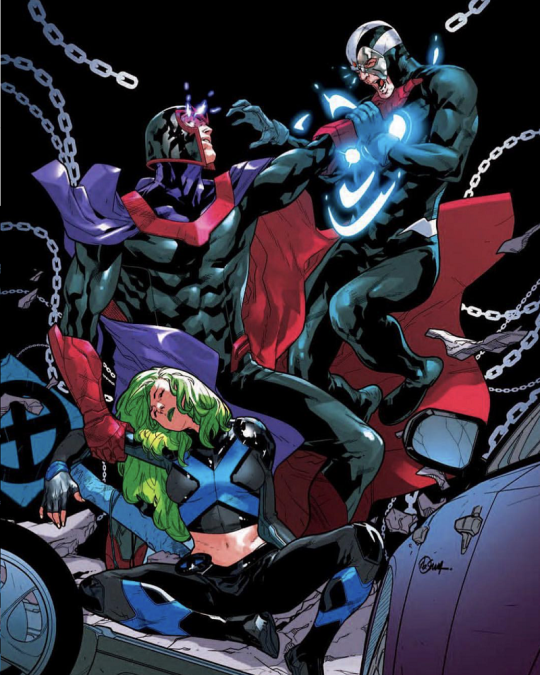
With Bunn, it’s been focusing on Magneto and Havok, and using Lorna to build them up at the expense of any agency or value in her own right. Her past trauma and history with her father, and the feelings and intellect she’d possess from both, have been ignored to a point where it’s absurd. It’s more obvious if you look at scenes from Blue and mentally swap the roles of Lorna and Magneto, or Lorna and Havok.
I believe a female writer would be more likely to avoid that, by virtue of having seen how rampant such depictions are and not wanting to see it repeated yet again. There’s no guarantee a female writer wouldn’t have the same problems seen with David and Bunn, but I think it’s less likely given lived experience.
I hope this answers things, though I have to admit I don’t understand what you meant by me contradicting myself. Could you explain, if this didn’t cover it?
P.S. – Thanks for asking this question. It’s been a while since anyone asked me which writers I think did good or best by Lorna, so it’s been a while since I got to write something like this.



 salarta