
I stand by the assertion this looks like an old family photo of a divorced couple in a lifetime movie about competitive skiing
ok but it is
I stand by the assertion this looks like an old family photo of a divorced couple in a lifetime movie about competitive skiing
ok but it is
In better news.


There are more pages, but I didn’t bother because Polaris isn’t in them and they’re not about her.
I’m okay with this. At present. There could be things I consider wrong with it that I don’t see right now.
I don’t particularly care for the “What have I done?” and “How could I be so stupid?” lines, but I can live with them for the time being. Specifically, I don’t care for those lines because they remind me too much of this page that was part of forcing Lorna into space with Havok.

The preview page lines aren’t bad like the example above. In the preview, Lorna’s focus is on how she shouldn’t be wasting time on thinking about Malice when the Raksha are in critical condition. There’s good reason for her to chide herself for that, unlike the example above. Still, it feels too similar, which is why I subjectively don’t care for the lines in that preview page.
It’s been a while since I properly said something about Dreamer’s death and how poorly The Gifted handled it, so I just really need to bring it back to the fore. I’m not dropping it.
Things have slowed because the show is out until Fall and its social media channels are practically dead. But my frustration and outrage are still very much alive, four months later.
Which is why I’m making this post of odds and ends of views people have expressed about her. Starting with a couple that are very recent.
And for the sake of full disclosure, the impetus of this is seeing one person out there who (not necessarily about Dreamer, just speaking generally) said they like how Gifted isn’t afraid to burn stories and concepts. This is to emphasize how even though as a general rule there’s some good in that, it was wrong in Dreamer’s case.
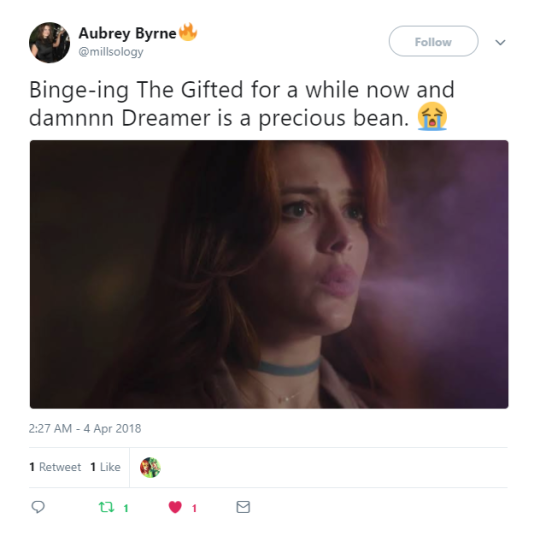
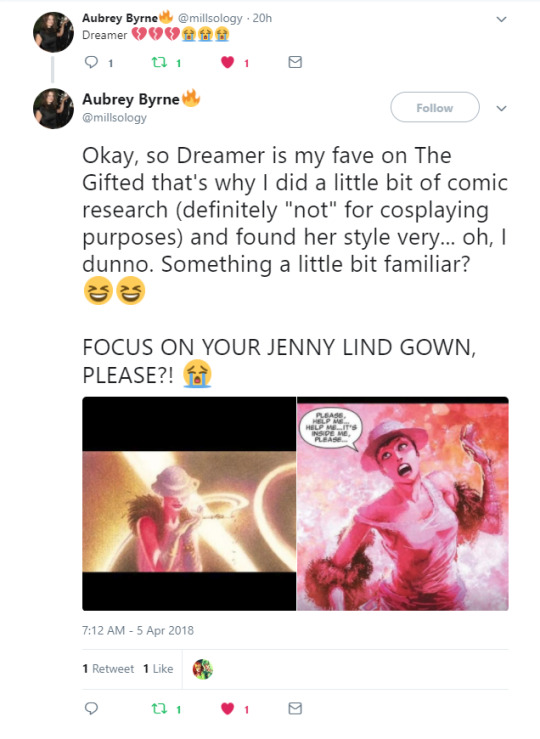
These are the latest I found. User loved Dreamer, was her favorite, disappointed in her death.

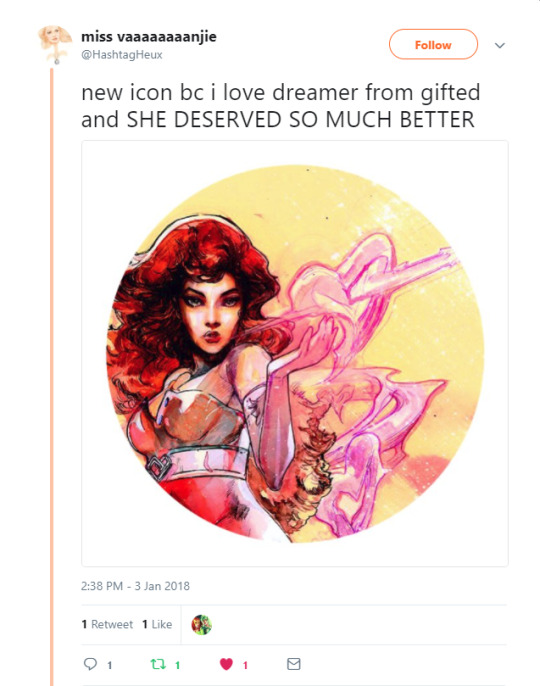
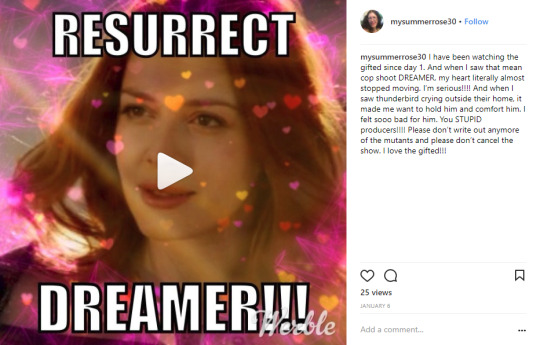
This is a general theme. These are not the only cases out there, though they’re the only ones that come up easily in the Twitter search I did (last being linked to via Twitter search).
I know for a fact there are a LOT more than just this because I found and posted them back when they were fresh.
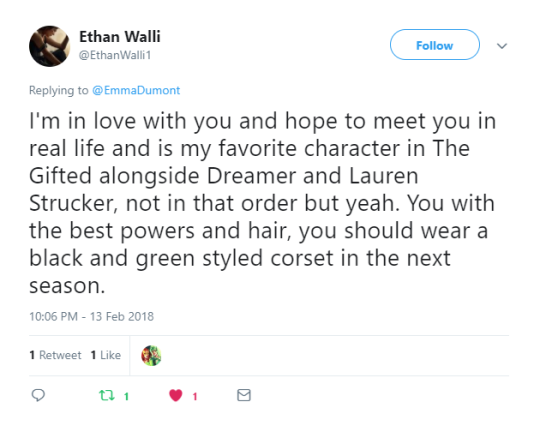

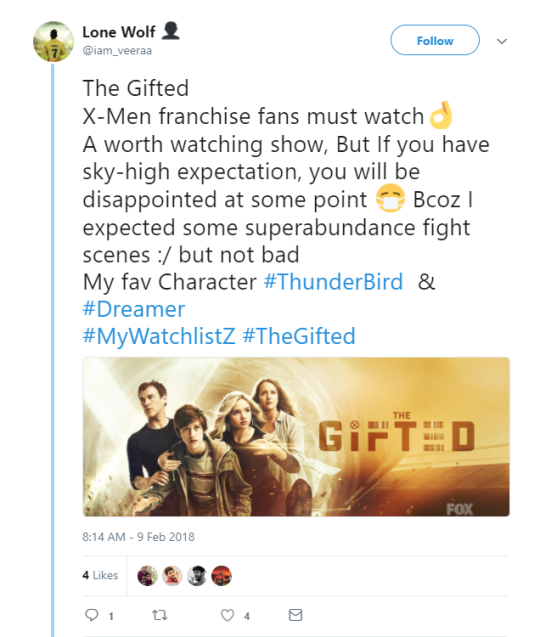
Again, Dreamer was a favorite for a lot of people. For some, she was the entire reason they watched. And reaction to her getting killed off, well…
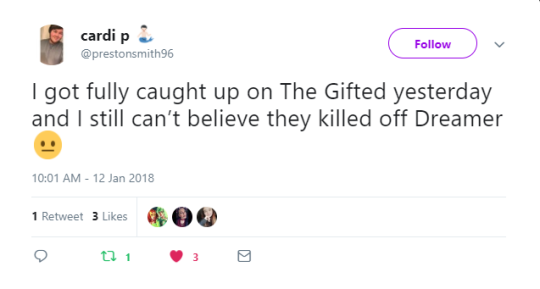
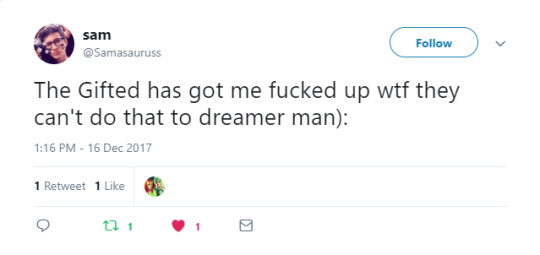
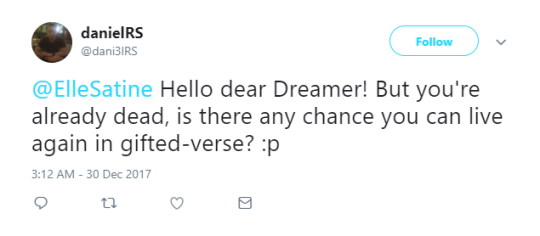
Aside from upsetting people, many want her brought back ASAP.
There are videos out there made as tributes to her, like this one published on March 24th by @anadearmas (post). People don’t make video tributes for “nobody characters” three months after they were killed off.
And if you look at the notes, you’ll see one reblog in there expressing frustration at how Dreamer was killed just to advance a romance between Thunderbird and Blink.
The view many have, and I’m sure it’s especially held by the people on the show who decided to give Dreamer such a disrespectful and poorly done death, is that Dreamer was a worthless extra. That she had no real value, that she could be killed off and nothing was lost.
But something was. Something really, really was lost when they decided to not only kill her off, but do so in the manner they did. It’s not just that they killed her off. It’s the way it happened. It’s the poor setup. The terrible framing. The execution so botched it didn’t look like they even put any thought or effort into it at all. They wanted to kill her, and making it happen was all that mattered to them.
Technically, you can say this post, these reactions, they’re all signs of good writing in that it got everyone to care this much about a character with so little comics history that she was effectively a new character made for the show.
But good writing isn’t just making you care about something. It’s also respecting the audience enough to not stab them in the back for caring. It’s recognizing they cared for a reason, they got invested for a reason, and rewarding that interest and care.
Which doesn’t have to mean “never kill the character.” It could mean kill them off with thought, and care, and respect. A character doesn’t have to live forever. They just need their value and impact acknowledged properly. Gifted failed to do that with Dreamer.
i don’t really like it but i’m still learning so yeah
check it out xx
Ugh I loved her too and I miss her. I’m pissed they killed her off just to jumpstart the romance between john and clarice 😑😑
To reiterate my stance: I don’t like the emphasis on “Magneto’s daughter” and phrases like “Lorna sure is Magneto’s daughter, isn’t she” because even intended in a positive and well-meaning way, I believe such remarks reduce her to just her connection to her father. As if she has nothing else to her beyond him, and as if she owes all her good qualities to him.
When you see Batgirl, people don’t say “she sure is Batman’s sidekick.”
When you see Supergirl, people don’t say “she sure is Superman’s cousin.”
An important connection between Batgirl and Batman, or between Supergirl and Superman, is acknowledged as it should be. But it doesn’t override who they are as their own characters.
To emphasize how this can be a problem and why it concerns me, I have two examples to give. One of them is, oddly enough, Supergirl.
Most people aware of comic books know all about how Batgirl was written as giving up on crimefighting and then paralyzed. Oracle was made out of that, but that was writers salvaging her from a plan to get rid of her.
What most people don’t know is that around the same time, Supergirl was killed off. Here’s the reason, found on the Wikipedia article for Supergirl (I don’t have access to the source material).
From Marv Wolfman, who wrote her death in Crisis on Infinite Earths:
Before Crisis it seemed that half of Krypton had survived the
explosion. We had Superman, Supergirl, Krypto, the Phantom Zone
criminals, the bottle city of Kandor, and many others. Our goal was to
make Superman unique. We went back to his origin and made Kal-El the
only survivor of Krypton. That, sadly, was why Supergirl had to die.
However, we were thrilled by all the letters we received saying
Supergirl’s death in Crisis was the best Supergirl story they ever read. Thank you. By the way, I miss Kara, too.
From Dick Giordano VP and executive editor at DC at the time:
Supergirl was created initially to take advantage of the high Superman
sales and not much thought was put into her creation. She was created
essentially as a female Superman. With time, writers and artists
improved upon her execution, but she never did really add anything to the Superman mythos—at least not for me.
You know where Supergirl is today. She even has her own TV show that’s become pretty popular. But back in the 80s, a year after her film? They killed her off.
Why? Because they perceived her as “just a female Superman,” “just Superman’s cousin,” as a character who had nothing unique and meaningful in her own right to make her worthy of keeping around when they already had Superman. They killed her because the overemphasis on her connection to Superman devalued her in their eyes.
My second example is sort of Supergirl but not: Power Girl. Remember these panels?

This is a writer trying to explain why Power Girl has a boob window in a way other than “because the people who created her wanted her to show cleavage.” Personally, I believe there are ways it could be explained that would serve Karen well, but that’s me, and it’s not the point I’m trying to make.
The point I’m trying to make is: this writer decided to fall back on defining Power Girl by her connection to Superman. These panels have been ridiculed rightly for the absurdity of the reason, the absurdity of how Power Girl is written as thinking and feeling, but it can’t be overlooked that this writer chose to frame it as Power Girl failing to find a symbol that would let her live up to Superman’s example. The absurdity of these panels is a direct consequence of overemphasizing Power Girl’s connection to Superman in the wrong way.
In all this, I’m not saying “Don’t refer to Lorna as Magneto’s daughter” or “Don’t say, do or support things that acknowledge that aspect of her.” It is a part of her identity and origins. It should be acknowledged and used.
But it’s possible to take it too far. It’s possible to take it so far that Lorna actively loses out on things she could and should be getting.
She could be left out of an event she should be in because “why have Magneto’s daughter when we already have Magneto.” Important parts of her identity can be ignored or forgotten because the writer doesn’t bother to look past her “Magneto’s daughter” exterior. Her unique qualities like the title Mistress of Magnetism can be rewritten as things she’s only allowed to have because of who her father is. She could get killed off because she’s “not unique enough” when they have Magneto, while X-23 and Daken and Jimmy and Old Man Logan and so on stick around.
Overemphasis on her being Magneto’s daughter can be just as bad as, if not worse than, ignoring that Magneto’s her father completely.
Again, I’m not saying don’t talk about it or celebrate it or support it. That’s presently a good side of her that I’d like to see developed in good, healthy ways. Just don’t make it all she is. And don’t perceive “let’s add Havok as her boyfriend” as sufficient differentiation, cause it’s not.

Polaris with a stuffed kitty that I sketched in class and then finished digitally.


favorite comic book characters
LORNA DANE/POLARIS
Then this is how the world ends. In rage and blood and fire.
I complain a lot about things Polaris isn’t getting that she should, or things happening to her that shouldn’t. I think I’m justified in that, but, I also realize that doing this means I sometimes overlook all the progress she’s made since I discovered she exists.
A lot of the progress she’s made is stuff that should’ve happened decades ago. It’s still progress, though, and good to remember much of it’s only happened since 2009.
That’s really a lot of catching up in a short time.
That’s not to say there aren’t things still missing, or lost opportunities along the way. One of the things that really should’ve happened on X-Men Blue and never did, for instance, was Lorna spending some quality time with teen Jean and teen Bobby. That was pretty much the thing unique to Blue that would’ve made her presence there meaningful. In the same vein of how All-New X-Factor never managed to take advantage of its modern corporate backdrop.
But in spite of the hurdles and paths not taken, Lorna’s really come a long way in a little shy of 10 years.
This post was more or less prompted by all the positive posts I’ve been seeing out there by fans of her. When I discovered her, it was more common for me to run into people who thought she was worthless. I still distinctly remember saying how Lorna should return from space, and one guy responding that she should be left in space to be forgotten and never used again.
Now, I see people talking about how badass she is. I see them talking about how much of a survivor she is and how her big draw is overcoming all the obstacles thrown at her. I see discussions about both her neurodiversity (bipolar) and her mental health issues (trauma). Whole articles on websites are dedicated to her, something I didn’t think I’d see at all back in 2009.
In short, lots and lots of people have come to see all the great things in Lorna that I’ve seen since I discovered her. It’s wonderful to see that awareness spread.
That’s the crux of most characters like Lorna: people are missing something they don’t even know they’re missing. Often times, it’s all about making people aware, whether it’s telling them about a character they didn’t know existed, or pointing out great qualities they never noticed before.
Someone I used to talk to once told me they’d read Lorna before but only really started to care and see her good qualities during the Austen era.
That’s really all it’s about. Being shown who the character is and what she can be for real. She’s tough, she’s hopeful, and she’s tough because she’s hopeful, even at her (in-character) lowest points.


 salarta